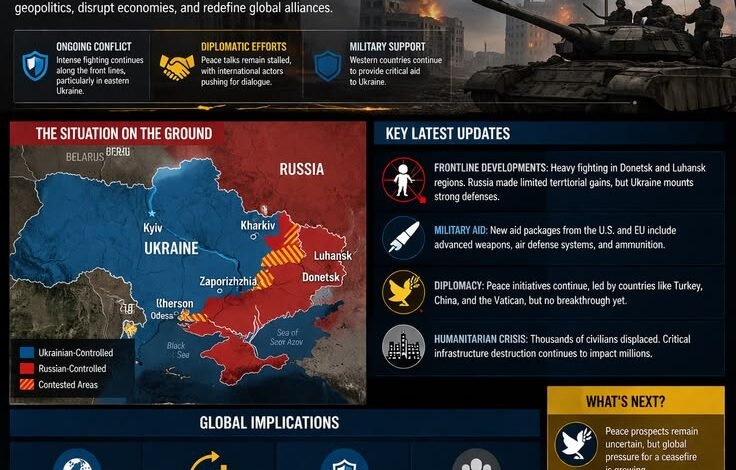
The war in Ukraine is entering another tense period as Russian attacks on Ukrainian cities intensify, Ukraine increases strikes against Russian military and energy targets, and international efforts to restart peace negotiations continue.
Recent developments have placed Kyiv under particular pressure. Russia has intensified attacks using drones and missiles, while Ukraine has promised to respond by increasing strikes against Russian oil refineries and other strategic infrastructure.
At the same time, Germany has announced a major new support package for Ukraine, and Ukrainian President Volodymyr Zelenskyy has indicated that Kyiv is ready to participate in new U.S.-backed talks with Russia.
These developments show that the war remains active on both the battlefield and the diplomatic front.
Russia Intensifies Attacks on Ukraine
One of the most significant recent developments is an increase in Russian attacks against Ukrainian cities and infrastructure.
On October 4, Russia said it had struck the Northern Bridge over the Dnipro River in Kyiv. Russian officials described the bridge as an important route for military and logistical transportation. Russia also reported strikes against vessels near Odesa and other infrastructure in southern Ukraine. The claims concerning the targets and damage could not be independently verified.
Ukraine, meanwhile, reported another large overnight Russian drone attack.
According to Ukraine’s Air Force, 135 drones were used in the attack during the night of October 3–4, with Ukrainian air defenses reporting that most were intercepted or jammed. Some strikes and falling debris nevertheless caused damage in several locations.
The attacks come as winter approaches, raising concerns about the security of Ukraine’s energy and heating systems.
Kyiv Is Facing Increasing Pressure
Kyiv has become an important focus of the latest Russian campaign.
Reports indicate that Russian forces have repeatedly targeted bridges and other infrastructure in the Ukrainian capital. The attacks have disrupted transportation and raised concerns about the city’s ability to maintain essential services.
The Washington Post reported that several bridges in Kyiv had been targeted within days, creating transportation problems and increasing concerns about the impact of further attacks as winter approaches.
For residents, the issue goes beyond military infrastructure.
Damage to bridges, energy facilities, transportation networks and communication systems can affect everyday life. Kyiv residents may face longer travel times, power disruptions and additional security restrictions if attacks continue.
The Ukrainian government has warned that Russia may increase pressure on major cities during the colder months.
Ukraine Says It Will Target Russian Oil Infrastructure
Ukraine has also increased its long-range attacks against targets inside Russia.
President Volodymyr Zelenskyy said Ukraine intends to intensify attacks on Russian oil refineries in response to Moscow’s increased aerial attacks against Ukrainian cities and infrastructure.
In an interview reported by Reuters on October 3, Zelenskyy said Ukraine would continue targeting Russian energy infrastructure while attempting to avoid civilian targets.
The strategy is significant because oil infrastructure is an important source of revenue for Russia and supports its wider economy and war effort.
However, attacks on energy infrastructure also create risks for further escalation.
Russia has already warned that it will increase strikes against Ukraine in response to Ukrainian attacks.
This creates a cycle in which attacks on strategic infrastructure are followed by retaliation, potentially expanding the scope of the conflict.
Germany Announces New Support for Ukraine
Germany has demonstrated that European support for Ukraine remains strong.
German Chancellor Friedrich Merz arrived in Kyiv on October 4 as Russian attacks were increasing.
During his visit, Germany announced more than €1.3 billion in additional support for Ukraine. The package includes around €1 billion in military assistance, including long-range weapons, drones and satellite technology, as well as approximately €350 million for energy infrastructure.
Germany and Ukraine also signed multiple agreements covering security cooperation and weapons production.
One particularly important area is drone production.
Modern warfare in Ukraine has increasingly relied on drones for reconnaissance, attacks and defense. Both Russia and Ukraine are developing larger numbers of increasingly sophisticated unmanned systems.
Germany’s cooperation with Ukraine on drone technology therefore represents a significant part of Europe’s broader effort to strengthen Ukrainian defenses.
Air Defense Remains a Major Ukrainian Need
One of Ukraine’s biggest challenges is protecting its cities and infrastructure from Russian missiles and drones.
The increasing use of drones has placed enormous pressure on Ukrainian air defenses.
Zelenskyy has repeatedly called for additional air-defense systems and interceptors, particularly as Russia increases attacks against infrastructure.
Germany’s latest support package includes air-defense assistance and interceptor systems intended to help Ukraine deal with Russian drones and missiles.
The issue is especially important as winter approaches.
Ukraine depends heavily on electricity and heating infrastructure during the colder months. Damage to power plants, substations and heating systems can create serious humanitarian problems.
Peace Talks Could Return
Despite the increase in military activity, diplomatic efforts have not completely disappeared.
Ukraine has indicated that it is ready to participate in new trilateral talks involving Ukraine, Russia and the United States.
Zelenskyy said on October 4 that Ukraine supports a U.S.-backed proposal for technical-level discussions later in October. The United Arab Emirates has been mentioned as a possible location, although another venue could also be chosen.
The possibility of talks is significant because previous negotiations have produced limited progress.
A new round of discussions could provide an opportunity to address issues such as a ceasefire, security guarantees, territorial disputes and the future relationship between Ukraine and Russia.
However, major disagreements remain.
Why Has Peace Been So Difficult?
The biggest challenge is that Russia and Ukraine continue to have fundamentally different positions on the future of the war.
Territory remains one of the most difficult issues.
Ukraine wants to preserve its territorial sovereignty and obtain meaningful security guarantees. Russia continues to demand concessions connected to territory and Ukraine’s future security arrangements.
Previous negotiations have struggled to bridge these differences.
The UK House of Commons Library reported in September that renewed U.S.-led talks had taken place but had achieved limited progress, while future trilateral talks involving the United States, Russia and Ukraine were being considered for October.
The continued military escalation makes negotiations even more difficult.
Countries are generally less willing to compromise when they believe battlefield developments could improve their negotiating position.
Ukraine Is Also Striking Targets in Russia
The conflict has increasingly extended beyond the traditional front lines.
Ukraine has been using drones and other long-range weapons to target military facilities, energy infrastructure and oil facilities inside Russia.
These attacks are intended to disrupt Russia’s ability to sustain military operations.
Russian authorities have repeatedly reported intercepting large numbers of Ukrainian drones over different regions.
Russia has responded with its own long-range strikes against Ukrainian cities and infrastructure.
This means the war is becoming increasingly dependent on long-range weapons and drone technology rather than only conventional ground fighting.
The Black Sea Remains Important
The Black Sea continues to be strategically important.
Ukraine relies on Black Sea routes for exports, while Russia has sought to maintain military and economic influence in the region.
Recent Russian reports have claimed strikes against vessels near Odesa, while Ukraine continues to monitor maritime security closely. The claims regarding the vessels and their cargo have not been independently verified.
The safety of commercial shipping is important because Ukraine remains a major agricultural producer.
Any prolonged disruption to Black Sea shipping can affect Ukrainian exports and international food markets.
Winter Could Become a Major Challenge
The approaching winter is one of the most important factors in the current situation.
Ukraine’s electricity and heating infrastructure has been repeatedly targeted during the war.
Cold weather increases the importance of reliable energy supplies. Damage to power stations, heating networks or electricity substations could create serious problems for civilians.
Ukraine is therefore preparing additional defenses and seeking international assistance to protect critical infrastructure.
Germany’s new funding for energy repairs is part of that effort.
Europe Remains Closely Involved
European governments continue to play an important role in supporting Ukraine.
Germany is one of Ukraine’s largest supporters, and other European countries continue to provide military equipment, financial assistance and humanitarian aid.
European governments also have a direct interest in the outcome of the war because Ukraine borders the European Union and the conflict has affected European security.
The war has also encouraged European countries to increase defense spending and reconsider their military preparedness.
What Could Happen Next?
The next few weeks could be particularly important.
Three developments deserve close attention.
First, the level of Russian attacks against Ukrainian cities and infrastructure will determine how severe the winter security challenge becomes.
Second, Ukraine’s campaign against Russian oil infrastructure could affect Russia’s economy while also increasing the risk of retaliation.
Third, proposed U.S.-backed talks could provide a diplomatic opening if Russia agrees to participate.
However, negotiations are unlikely to be easy.
Military developments and diplomatic efforts are currently happening at the same time, creating an uncertain environment.
Final Thoughts
So, what are the latest developments in Ukraine?
The war is entering another period of intense military activity. Russia has increased attacks on Kyiv and other Ukrainian cities, while Ukraine is expanding its long-range strikes against Russian oil and strategic infrastructure.
At the same time, European support remains strong. Germany has announced more than €1.3 billion in new assistance, including military and energy support.
There is also a potential diplomatic opening. Ukraine says it is ready for U.S.-backed trilateral talks with Russia, potentially in the United Arab Emirates later in October.
Whether those talks can produce meaningful progress remains uncertain.
For now, the war continues on multiple fronts: military, economic, technological and diplomatic. The coming weeks will show whether the current escalation leads to an even wider conflict or creates enough pressure for the parties to return seriously to negotiations.