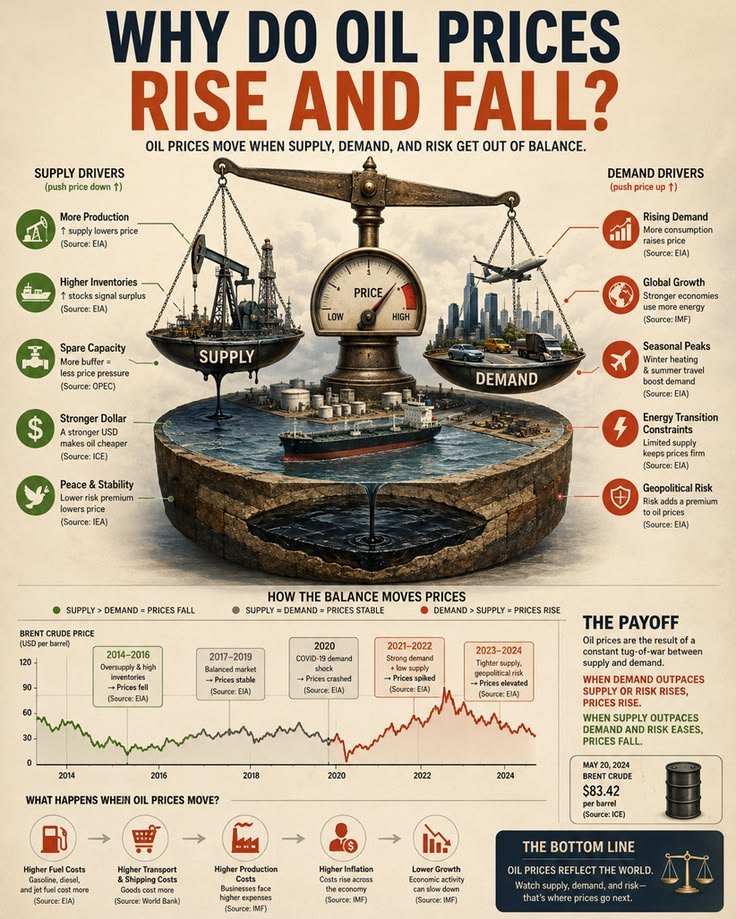
Global oil prices have risen sharply as geopolitical tensions, supply disruptions and uncertainty surrounding the Middle East continue to affect energy markets.
The price of crude oil has become one of the most closely watched economic indicators because oil is essential to transportation, manufacturing, agriculture, aviation and many other industries. When crude becomes more expensive, the effects can eventually reach businesses and households through higher fuel, transportation and production costs.
In early October 2026, Brent crude remained above $100 per barrel. On October 4, OPEC+ agreed to keep its November production targets unchanged, despite continuing concerns about Middle Eastern supply disruptions. Reuters reported that Gulf producers were still producing below their official targets because of the conflict involving Iran.
So, why are global oil prices rising, and what could happen next?
Middle East Tensions Are the Biggest Factor
The most important factor currently affecting oil prices is geopolitical uncertainty in the Middle East.
The conflict involving Iran has disrupted energy exports and created concerns about the safety of oil tankers and other commercial vessels.
Investors do not need a complete shutdown of oil supplies to become concerned. Even the possibility that supplies could be interrupted can cause traders to push prices higher.
The Strait of Hormuz is particularly important because it is one of the world’s major oil transportation routes. Before the current conflict, roughly 20% of global oil supply moved through the waterway.
Although oil flows through Hormuz have recovered significantly from the worst period of disruption, security risks remain.
This uncertainty has created what economists call a risk premium in oil prices. Traders are effectively paying more because they are concerned that future supplies could become less reliable.
The Strait of Hormuz Remains Critical
The Strait of Hormuz connects the Persian Gulf with the Gulf of Oman and the Arabian Sea.
Major oil-producing countries such as Saudi Arabia, Iraq, Kuwait, the United Arab Emirates and Qatar depend heavily on maritime routes in the region.
The U.S. Energy Information Administration has described Hormuz as one of the world’s most important oil chokepoints. In 2024, approximately 20 million barrels of oil per day passed through the strait, representing about one-fifth of global petroleum liquids consumption.
The problem is that there are limited alternatives.
Saudi Arabia and the UAE have pipelines that can bypass the waterway, but they cannot replace all the volumes normally transported through Hormuz.
This means any serious disruption can quickly affect expectations about global oil supplies.
Supply Has Been Disrupted
The current price increase is also connected to actual disruptions in oil production and exports.
Earlier in the conflict, oil flows through Hormuz fell dramatically. The International Energy Agency reported that flows dropped from roughly 20 million barrels per day before the conflict to an average of only 2.7 million barrels per day during March, April and May 2026.
Although flows have since improved, the disruption created a major gap in global energy supplies.
Producers have responded by using alternative routes, pipelines and other methods to move crude.
But these alternatives can be more expensive and complicated.
The market therefore remains sensitive to any new attack, shipping disruption or diplomatic breakdown.
OPEC+ Is Keeping Production Targets Unchanged
Another important factor is the decision by OPEC+ to maintain its current production targets.
On October 4, the group agreed to keep November output targets unchanged.
OPEC+ has increased production targets during much of 2026, but the increases have not fully translated into actual production because of the disruption caused by the Middle East conflict.
Reuters reported that the seven core OPEC+ members produced about 25 million barrels per day in August, roughly 5 million barrels per day below their February pre-war levels.
That difference matters.
When actual production remains below potential levels while demand continues, the market can become tighter.
A tighter market makes oil prices more sensitive to unexpected disruptions.
China Is Adding Pressure to Fuel Markets
China is another factor behind recent oil-market concerns.
Reuters reported that Chinese refiners suspended exports of oil products beyond Hong Kong and Macau, a move that contributed to fears of tighter global fuel supplies.
China is one of the world’s largest energy consumers.
When a major country changes its fuel-export policy, international traders pay close attention because it can alter the amount of refined petroleum available to other markets.
The move has been particularly important for diesel markets.
Diesel is essential for trucking, agriculture, construction, mining and industrial activity.
A shortage of diesel can therefore create economic pressure even when crude oil supplies themselves appear relatively adequate.
Refining Capacity Is Another Problem
The global oil market is not simply about crude production.
Crude oil must be processed in refineries before it becomes gasoline, diesel, jet fuel and other petroleum products.
That means the world can have sufficient crude oil while still experiencing shortages of certain refined fuels.
Recent market analysis has pointed to a global refining problem, with disruptions and limited spare refining capacity contributing to higher prices for products such as diesel and jet fuel.
This distinction is important.
Consumers do not buy barrels of crude oil directly. They buy products made from crude.
If refinery capacity is constrained, fuel prices can rise even if crude production remains relatively strong.
Shipping Costs Are Increasing
Oil prices are also affected by the cost of transporting crude and refined products.
When ships travel through areas affected by conflict, shipping companies may face higher insurance premiums and additional security expenses.
Some vessels may also choose longer alternative routes.
Longer journeys require more fuel and take more time.
Those costs eventually become part of the price of delivered oil and petroleum products.
The current situation around the Middle East has therefore created additional expenses throughout the energy supply chain.
Investors Are Worried About Further Escalation
Oil prices respond not only to what is happening but also to what traders think might happen next.
This is why diplomatic developments can cause large movements in oil prices.
When investors believe that negotiations may reduce tensions, prices can fall.
When they believe a conflict could become larger, prices can rise quickly.
On October 1, for example, Brent crude rose more than $4 per barrel after reports of increased U.S. military deployments to the Middle East and China’s suspension of some fuel exports. Brent settled at $102.31 per barrel, while U.S. West Texas Intermediate settled at $92.87.
This demonstrates how quickly oil markets can respond to geopolitical news.
Why Does the Price of Oil Matter?
Oil is deeply connected to the global economy.
Transportation depends heavily on petroleum products.
Cars use gasoline. Trucks use diesel. Aircraft use jet fuel. Ships use marine fuels.
Oil is also used in the production of plastics, chemicals, synthetic materials and numerous industrial products.
When energy prices rise, businesses may face higher operating costs.
For example, a delivery company may spend more on diesel. An airline may pay more for jet fuel. A farmer may pay more to operate machinery.
Companies may eventually pass some of these higher costs to consumers.
This can contribute to inflation.
Higher Oil Prices Can Affect Interest Rates
Oil prices can also influence central-bank decisions.
If higher energy costs cause broader inflation to rise, central banks may become more cautious about cutting interest rates.
Higher interest rates can increase borrowing costs for households and businesses.
This can affect mortgages, business investment and consumer spending.
The relationship is not automatic, but energy shocks can complicate monetary policy because central banks have to balance inflation risks against economic growth.
Oil Prices Can Also Help Producing Countries
Higher oil prices are not negative for everyone.
Countries that export large quantities of oil can receive significantly more revenue when prices increase.
Governments may collect more taxes and royalties from energy companies.
Oil producers can use the additional income to support government budgets, infrastructure projects or investment.
However, higher prices can also create challenges for oil-producing countries if the higher revenue is accompanied by market instability or reduced demand.
Could Oil Prices Rise Further?
That depends largely on geopolitical developments.
If tensions in the Middle East decline and shipping through the Strait of Hormuz becomes more secure, some of the risk premium could disappear.
More reliable exports could put downward pressure on prices.
However, if attacks continue or the conflict expands, prices could rise further.
OPEC+ production decisions will also matter.
The organization has another scheduled meeting on November 1, where members are expected to reassess market conditions.
Investors will also be watching China’s fuel policies, refinery operations, U.S. production and global economic demand.
What Could Bring Oil Prices Down?
Several developments could reduce oil prices.
A lasting diplomatic agreement in the Middle East would likely reduce concerns about supply disruptions.
Improved shipping through the Strait of Hormuz could also lower transportation and insurance costs.
Higher production from major oil producers could increase available supply.
A slowdown in the global economy could reduce demand for fuel.
Releases from strategic petroleum reserves could provide temporary additional supplies.
The G7 has already announced plans to release emergency oil and fuel reserves in response to the current market pressure.
However, strategic reserves are generally designed as a temporary response rather than a permanent replacement for normal production.
What Should Consumers Watch?
For consumers, the most important indicators are crude oil prices, gasoline and diesel prices, refinery capacity and geopolitical developments.
If Brent crude remains above $100 per barrel for an extended period, the impact could become more visible across transportation and other industries.
Diesel deserves particular attention because it plays an important role in freight, agriculture and construction.
Consumers should also watch currency movements because oil is generally traded in U.S. dollars.
A weaker local currency can make imported oil more expensive even if the international oil price remains unchanged.
Final Thoughts
So, why are global oil prices rising?
The current increase is being driven primarily by Middle East conflict, concerns over supply disruptions, shipping risks, tight production, refining constraints and uncertainty about future energy flows.
The Strait of Hormuz remains central to the situation because of its importance to global oil transportation. Although flows through the waterway have recovered significantly from their lowest levels, the market remains sensitive to any threat to shipping.
At the same time, OPEC+ has decided to keep November production targets unchanged, while actual output from key members remains below pre-conflict levels.
The recent rise in oil prices is therefore not simply a story about supply and demand.
It is also a story about geopolitics, security, shipping, refining capacity and investor confidence.
If diplomatic tensions ease and energy flows continue to recover, prices could eventually move lower. But if the Middle East conflict worsens or important shipping routes become disrupted again, oil markets could face another sharp increase.
For households and businesses around the world, the direction of oil prices will remain important because energy costs influence almost every part of the modern economy.