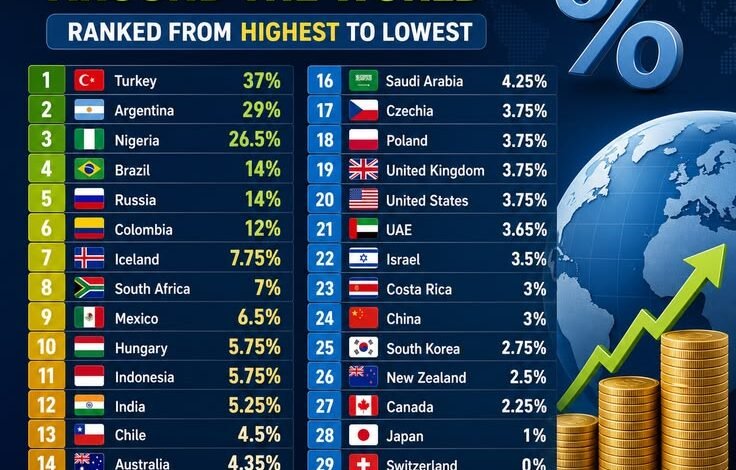

High interest rates are having a major influence on financial markets around the world. From government bonds and stock markets to currencies, housing and business investment, borrowing costs affect almost every part of the global economy.
Central banks raise interest rates mainly to control inflation and prevent prices from rising too quickly. But higher rates also make borrowing more expensive, which can slow consumer spending, business investment and economic growth.
In 2026, the situation has become particularly complicated because central banks are dealing with persistent inflation pressures, higher energy prices and geopolitical uncertainty.
The European Central Bank raised its three key interest rates by 25 basis points in September 2026, citing continued inflationary pressure linked partly to the conflict in the Middle East. Its deposit rate was raised to 2.50%, while its main refinancing rate reached 2.65%.
In the United States, the Federal Reserve’s September decision placed the federal funds target range at 3.75% to 4%.
These decisions demonstrate why interest rates remain one of the most important issues for investors.
So, how are high interest rates affecting global markets?
Why Do Central Banks Raise Interest Rates?
Central banks typically increase interest rates when inflation is too high or when they believe the economy is growing too quickly.
Higher interest rates increase the cost of borrowing.
For example, a business considering a new factory may decide not to proceed if the cost of financing becomes too high. A household considering a mortgage may also delay buying a home.
The idea is relatively simple: when borrowing becomes more expensive, people and companies generally spend and invest less.
That can reduce demand for goods and services and eventually help bring inflation under control.
However, the process can take time.
Higher Rates Are Putting Pressure on Bond Markets
Bond markets are among the first places where interest-rate changes become visible.
When central banks raise rates, newly issued bonds generally offer higher yields.
Existing bonds with lower interest payments can become less attractive.
As a result, their market prices may fall.
This relationship is particularly important for government bonds.
In 2026, global bond markets have faced additional pressure because investors are concerned about inflation, government borrowing and energy prices.
Reuters reported in early October that a global bond selloff had pushed government yields higher, with the U.S. 10-year Treasury yield reaching its highest level since 2002.
Higher government bond yields can have consequences beyond the bond market because they influence borrowing costs throughout the financial system.
Stock Markets Face a More Complicated Environment
High interest rates can create pressure on stock markets because they change how investors value companies.
When government bonds offer higher yields, investors may have less incentive to take risks in stocks.
At the same time, higher borrowing costs can reduce corporate profits.
Companies that rely heavily on debt may have to spend more money servicing loans.
Businesses may also postpone expansion plans because financing new projects becomes more expensive.
However, higher interest rates do not automatically cause stock markets to fall.
Companies with strong cash flows, low debt and growing earnings can sometimes perform well even when rates are high.
Recent market conditions demonstrate this complexity. Despite elevated borrowing costs, strong corporate earnings and continued investment in artificial intelligence have supported parts of the U.S. stock market. Reuters reported that the AI investment cycle remained a major force supporting global markets in late September 2026.
This means investors are balancing two competing forces: expensive money on one side and strong corporate growth on the other.
Technology Stocks Can Be Particularly Sensitive
Technology companies can be affected significantly by interest rates.
Many technology companies are valued based on expectations about future profits.
When interest rates rise, future earnings can become less valuable when calculated in today’s money.
This can put pressure on companies whose stock prices already reflect high expectations for future growth.
However, the current AI investment boom has provided an important counterweight.
Companies involved in artificial intelligence, data centers, semiconductors and cloud computing continue to attract enormous investment.
The result is a market where some technology stocks remain strong despite higher interest rates.
If economic growth slows substantially, however, investors could become more cautious about expensive growth stocks.
Borrowing Is Becoming More Expensive
For consumers and businesses, one of the most direct effects of high interest rates is higher borrowing costs.
Banks generally pass higher central-bank rates through to loans and other forms of credit.
Businesses may therefore face higher costs when borrowing money for expansion.
Consumers may pay more for mortgages, personal loans, credit cards and other forms of borrowing, depending on their country’s financial system.
Higher borrowing costs can reduce spending.
Someone who has to spend more money servicing debt has less money available for restaurants, travel, cars and other purchases.
That can eventually affect company revenues.
Housing Markets Are Under Pressure
Real estate is particularly sensitive to interest rates.
Higher mortgage rates can make monthly housing payments more expensive.
For example, a buyer who could previously afford a $300,000 mortgage may find that the same loan becomes much more expensive when interest rates increase.
Some potential buyers respond by delaying purchases.
Others reduce the amount they are willing to borrow.
This can slow housing demand.
Developers can also face higher financing costs, making new construction more expensive.
However, the effect varies greatly between countries because mortgage structures are different.
In countries where homeowners have long-term fixed-rate mortgages, existing borrowers may be protected from immediate rate increases.
In countries where variable-rate or short-term mortgages are common, households can feel the impact much faster.
Higher Rates Can Strengthen a Currency
Interest rates can also influence foreign-exchange markets.
When a country offers relatively attractive interest rates, international investors may move money into its bonds and other assets.
This can increase demand for the country’s currency.
The U.S. dollar has benefited from this dynamic in 2026.
Reuters reported in early October that the dollar had strengthened significantly against the euro during a global bond selloff, helped by higher U.S. yields and concerns about European fiscal and inflation pressures.
A stronger dollar can have international consequences because many commodities, including oil, are priced in dollars.
Countries whose currencies weaken against the dollar may therefore face higher costs for imported commodities.
Emerging Markets Can Face Greater Pressure
Higher interest rates in major economies can be particularly difficult for emerging markets.
Investors may move money toward assets in countries offering attractive returns with lower perceived risk.
If capital leaves an emerging market, its currency can weaken.
A weaker currency can make imports more expensive and increase inflation.
Governments and central banks may then face pressure to raise their own interest rates.
India is one example of a country facing this challenge.
Reuters reported that foreign investors withdrew approximately $26 billion from Indian equities and debt in 2026 as interest-rate differences changed and global financial conditions tightened.
This demonstrates how monetary policy in major economies can affect financial conditions far beyond their borders.
Governments Are Also Feeling the Pressure
Higher interest rates affect governments because governments borrow money too.
When bond yields increase, issuing new debt becomes more expensive.
Countries with large amounts of government debt can therefore face significantly higher interest expenses.
This can create difficult budget decisions.
Governments may have to spend more money on interest payments while having less available for infrastructure, healthcare, education or other programs.
Fiscal concerns can then influence bond markets.
Investors may demand even higher yields if they become worried about a government’s ability to manage its debt.
This can create a cycle of rising borrowing costs.
High Rates Can Slow Global Economic Growth
One of the biggest effects of high interest rates is slower economic activity.
Businesses may reduce investment.
Consumers may spend less.
Housing construction can weaken.
Government borrowing becomes more expensive.
These factors can reduce economic growth.
However, central banks generally accept some economic slowdown when they believe it is necessary to control inflation.
The challenge is finding the right balance.
If rates remain too high for too long, economies could experience unnecessary weakness.
If rates are reduced too quickly, inflation could return.
Inflation Is Complicating the Situation
The current environment is especially difficult because inflation is being influenced by energy and geopolitical developments.
The European Central Bank said its September 2026 decision was partly driven by inflation pressures connected to the conflict in the Middle East. It projected euro-area headline inflation at an average of 3.0% in 2026.
This creates a difficult problem for central banks.
Higher interest rates can reduce demand, but they cannot directly produce more oil, gas or food.
If inflation is caused partly by supply disruptions, monetary policy has limited ability to solve the underlying problem.
Nevertheless, central banks may keep rates higher for longer to prevent temporary supply shocks from becoming persistent inflation.
Oil Prices Are Making the Situation More Difficult
Energy prices are an important part of the current interest-rate story.
Higher oil prices can increase transportation and production costs.
If businesses pass those costs to consumers, inflation can rise.
That can make central banks less willing to cut interest rates.
Recent financial-market data show how closely oil prices and bond yields have become connected.
The Financial Times reported that the relationship between oil prices and U.S. Treasury yields in September 2026 was the strongest since the Gulf War era, reflecting the influence of Middle East energy disruptions on inflation expectations.
This means developments in energy markets can increasingly affect interest-rate expectations.
Investors Are Watching Central Banks Closely
Financial markets constantly try to predict what central banks will do next.
Investors examine inflation reports, employment figures, economic growth data and central-bank statements.
A small change in language from a central bank can sometimes cause significant market movements.
If investors believe rates will remain high, bond yields may rise and stocks may come under pressure.
If investors expect rate cuts, bond prices may increase and investors may become more willing to buy riskier assets.
This is why central-bank meetings have become major events for global financial markets.
Could High Interest Rates Last Longer?
The answer depends on inflation and economic growth.
If inflation falls steadily, central banks could eventually reduce interest rates.
If inflation remains elevated because of energy prices, strong demand or supply disruptions, rates may remain higher.
In the United States, the Federal Reserve’s September policy decision placed the federal funds target range at 3.75% to 4%.
In Europe, the ECB’s September rate increase demonstrated that policymakers remain concerned about persistent inflation.
This suggests investors should not assume that lower interest rates are guaranteed in the near future.
What Does This Mean for Global Markets?
The effects of high interest rates can be summarized across several major markets:
Stocks: Higher rates can reduce valuations and increase corporate borrowing costs, although strong earnings can offset some of the pressure.
Bonds: Existing bond prices can fall as new bonds offer higher yields.
Currencies: Countries with relatively high interest rates can attract international capital and experience stronger currencies.
Real estate: Higher mortgage rates can reduce housing demand.
Emerging markets: Capital outflows and weaker currencies can increase financial pressure.
Commodities: Higher rates can reduce demand, while geopolitical supply disruptions can push commodity prices higher.
Businesses: Financing becomes more expensive, potentially reducing investment and expansion.
Final Thoughts
So, how are high interest rates affecting global markets?
The answer is that they are raising borrowing costs, influencing bond yields, changing stock valuations, affecting currencies and putting pressure on businesses, consumers and governments.
But the 2026 environment is more complicated than a typical interest-rate cycle.
Central banks are dealing with inflation at the same time that geopolitical conflicts are affecting energy prices and supply chains. The ECB has already raised rates because of continuing inflationary pressure, while the Federal Reserve is maintaining a relatively restrictive policy stance.
For investors, this means volatility may remain elevated.
Markets will continue to watch inflation, employment, economic growth, oil prices and central-bank decisions closely.
Ultimately, high interest rates can help bring inflation under control, but they also come with economic costs. The challenge for policymakers is to keep inflation contained without slowing the global economy so much that financial stress becomes a larger problem.
As 2026 progresses, the direction of interest rates will remain one of the most important factors shaping global financial markets.