The global economy is constantly changing, but 2026 has brought an unusual combination of forces that are reshaping growth, inflation, trade and financial markets.
Countries are dealing with geopolitical conflicts, changing energy prices, higher borrowing costs, trade tensions and rapid advances in artificial intelligence. At the same time, businesses are adapting their supply chains while governments are trying to protect their economies from unexpected shocks.
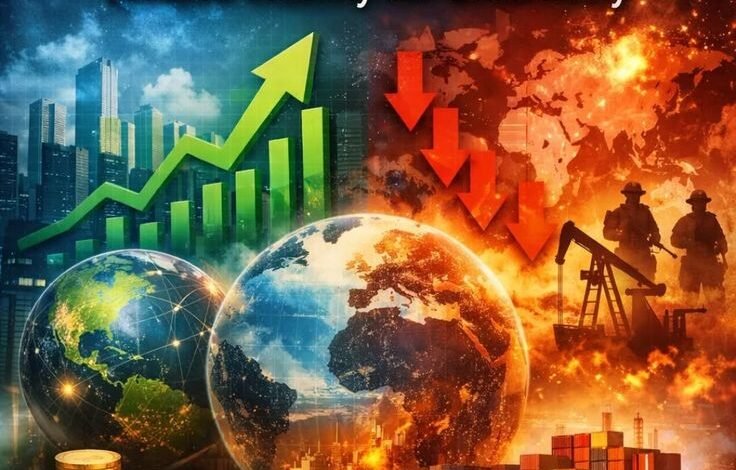
The result is an uneven global economy. Some countries and industries are benefiting from technology investment, while others are struggling with higher energy costs, inflation and weaker demand.
The International Monetary Fund projected global growth at 3.0% for 2026, while warning that the effects of war, trade fragmentation and financial-market repricing remain important risks.
So, what is driving these changes, and what could they mean for the global economy?
Geopolitical Conflicts Are Reshaping the Economy
One of the biggest forces affecting the global economy is geopolitics.
Wars and international tensions can disrupt energy supplies, transportation routes, trade and investment.
The conflict in the Middle East has been particularly important in 2026 because the region plays a major role in global energy markets. Disruptions around the Strait of Hormuz have affected oil and gas flows and contributed to a major energy shock. The World Bank described the disruption as an unprecedented shock to the oil market.
When energy prices rise, the effects can spread throughout the economy.
Transportation becomes more expensive. Businesses face higher production costs. Consumers may pay more for fuel and other goods.
This can create a difficult situation in which economic growth slows while inflation increases.
Energy Prices Are Having a Major Impact
Oil and gas remain central to the global economy.
Even as countries invest more heavily in renewable energy, the world still relies heavily on fossil fuels for transportation, electricity generation and industrial production.
The current energy disruption has demonstrated how quickly problems in one region can affect countries thousands of miles away.
The World Bank’s 2026 commodity outlook projected global commodity prices to rise significantly because of Middle East supply disruptions, with energy and fertilizer prices facing particularly strong upward pressure.
Higher energy prices can also affect food prices.
Farmers use fuel and fertilizer to produce crops, while food companies depend on transportation and energy throughout their supply chains.
That means an energy shock can eventually become a food-price problem.
Interest Rates Are Still Influencing Growth
Interest rates remain another major factor.
Central banks use interest rates to control inflation and influence economic activity.
When rates are high, borrowing becomes more expensive for households, businesses and governments.
Consumers may delay buying homes or cars. Companies may postpone investments or expansion projects.
Governments can also face higher interest payments on newly issued debt.
This can slow economic activity.
However, central banks must balance growth against inflation. Cutting interest rates too quickly could cause inflation to remain high, while keeping rates elevated for too long could weaken economic growth.
This balancing act has become more difficult because some of the current inflation pressure is coming from energy and supply disruptions rather than excessive consumer demand.
Trade Tensions Are Changing Global Commerce
International trade is also undergoing major changes.
Governments are increasingly using tariffs, export restrictions and industrial policies to protect strategic industries.
The result is a global trading system that is becoming more complicated.
Companies that once relied on international suppliers may now be looking for alternative sources closer to home.
Some businesses are moving production to different countries to reduce geopolitical and trade risks.
This does not necessarily mean globalization is disappearing.
Instead, global supply chains are evolving.
The OECD has found that global value chains have remained resilient despite recent shocks, while businesses are adapting their production networks and increasingly relying on services.
Artificial Intelligence Is Creating a New Economic Force
Artificial intelligence is one of the most important positive forces affecting the global economy.
Businesses are investing heavily in AI systems, data centers, semiconductors and cloud infrastructure.
The technology is being used in industries ranging from finance and healthcare to manufacturing, transportation and marketing.
The IMF has identified the technology investment cycle as an important source of economic strength in 2026.
Its July outlook noted that AI-driven demand is benefiting countries integrated into global technology supply chains.
AI could increase productivity by allowing companies to automate repetitive tasks, analyze large amounts of information and develop new products and services.
However, it could also create disruption in labor markets.
Some jobs may change significantly as companies introduce AI tools, while demand for workers with technical and digital skills could increase.
Technology Investment Is Supporting Some Economies
The AI boom is not only benefiting software companies.
It is creating demand for computer chips, data centers, electricity, networking equipment and specialized infrastructure.
Countries that manufacture semiconductors or supply important components can benefit from this investment.
The United States and several Asian economies are particularly important to the global technology supply chain.
This is one reason the global economy can continue growing even while other parts of the world face significant challenges.
Technology investment is helping offset some of the weakness caused by geopolitical uncertainty and higher energy costs.
China Is Going Through an Economic Transition
China remains one of the world’s most important economies, but its growth model is changing.
For many years, China’s rapid growth was strongly supported by property development, manufacturing and infrastructure investment.
Today, China is attempting to increase the importance of technology, advanced manufacturing and domestic consumption.
The IMF projected China’s economy to grow by around 4.3% in 2027, after a period of slower growth compared with its earlier expansion rates.
China’s economic performance matters globally because it is a major consumer of commodities and a major exporter of manufactured products.
A slowdown in Chinese demand can affect countries that export oil, metals, agricultural products and other commodities.
Governments Are Dealing With Rising Debt
Public debt is another major factor shaping the global economy.
Governments around the world borrowed heavily during the pandemic and have faced additional spending pressures from wars, energy subsidies, infrastructure investment and social programs.
Higher interest rates make those debts more expensive to service.
Recent economic analysis has highlighted public debt and the search for stronger growth as major concerns for policymakers.
Governments therefore face a difficult choice.
They need to support economic growth and protect vulnerable households, but they also need to maintain sustainable public finances.
Excessive borrowing can eventually increase financial-market pressure and reduce governments’ ability to respond to future crises.
Supply Chains Are Becoming More Resilient
Another important change is the way companies manage supply chains.
The pandemic demonstrated the risks of relying too heavily on a single country or supplier.
Geopolitical tensions have reinforced those concerns.
Companies are now paying more attention to supply-chain resilience.
They may keep larger inventories, use multiple suppliers or move some production to different countries.
This can make businesses less vulnerable to individual disruptions.
However, it can also increase costs.
Producing goods in multiple locations may be more expensive than concentrating production in the cheapest location.
The global economy is therefore balancing efficiency against security.
Emerging Markets Face Both Risks and Opportunities
Developing economies are experiencing mixed effects from global economic changes.
Some countries benefit from higher demand for commodities, technology and manufacturing.
Others are more vulnerable to higher energy prices, expensive borrowing and currency depreciation.
For example, countries that import most of their energy can suffer when oil and gas prices rise.
Countries that export energy or important raw materials may benefit from higher commodity prices.
This creates very different economic conditions from one country to another.
The World Bank has warned that several developing regions are facing weaker growth because of energy-market disruptions and broader global uncertainty.
Inflation Remains an Important Concern
Inflation is another major force driving economic changes.
Although inflation had been falling in many countries, energy disruptions have created new price pressures.
The OECD warned that the 2026 energy shock is pushing inflation higher while weakening global growth. Under its scenario where energy disruptions are temporary, global growth was projected to slow from 3.4% in 2025 to 2.8% in 2026.
This combination is particularly difficult for policymakers.
If prices rise while economic growth weakens, governments and central banks have fewer easy solutions.
Consumers may also feel pressure as household budgets are squeezed by higher costs.
Climate Change Is Influencing Economic Decisions
Climate change is increasingly becoming an economic issue.
Extreme weather can damage infrastructure, disrupt agriculture and increase insurance costs.
Governments are also investing more in renewable energy, electricity networks and climate-resilient infrastructure.
The transition away from fossil fuels is creating new industries while increasing demand for minerals used in batteries, electric vehicles and renewable-energy technologies.
This is changing international trade and creating new geopolitical competition over critical minerals.
Countries that control important mineral resources could become more strategically important.
The Global Economy Is Becoming More Fragmented
Perhaps one of the biggest changes is the growing fragmentation of the global economy.
Countries are increasingly considering national security when making economic decisions.
Trade policy, energy policy, technology policy and foreign policy are becoming more closely connected.
Businesses are also adapting to this environment.
Instead of simply asking where production is cheapest, companies increasingly ask where production is safest and most reliable.
This could result in a global economy that is less efficient in some areas but potentially more resilient to major disruptions.
What Could Happen Next?
The future direction of the global economy will depend on several major developments.
If geopolitical conflicts ease, energy markets could stabilize and inflationary pressure could decline.
If conflicts continue or expand, energy prices and supply-chain disruptions could remain major concerns.
Technology investment could provide an important source of growth if AI increases productivity.
However, a sharp correction in technology markets could create financial instability.
Interest-rate decisions will also remain important.
Central banks will need to determine whether inflation is temporary or persistent and decide how quickly monetary policy should change.
Final Thoughts
So, what is driving changes in the global economy?
There is no single answer.
The global economy is being shaped by geopolitical conflicts, energy prices, interest rates, trade tensions, artificial intelligence, changing supply chains, government debt, climate pressures and shifts in major economies such as China and the United States.
Some of these forces are creating economic challenges, while others are creating new opportunities.
The biggest challenge is that many of them are happening at the same time.
The IMF expects global growth to remain positive in 2026, but its forecast also highlights the uneven effects of war and technology.
This means the global economy is not simply moving toward either a boom or a recession. Instead, different countries, industries and households are experiencing very different conditions.
Technology is creating new opportunities, while energy disruptions are increasing costs. Trade is becoming more strategic, while companies are redesigning supply chains. Governments are trying to support their economies while dealing with rising debt.
As these forces continue to interact, the global economy is likely to remain unpredictable.
For businesses, investors and households, understanding these major trends will be increasingly important because decisions made in one part of the world can have consequences across the global economy.