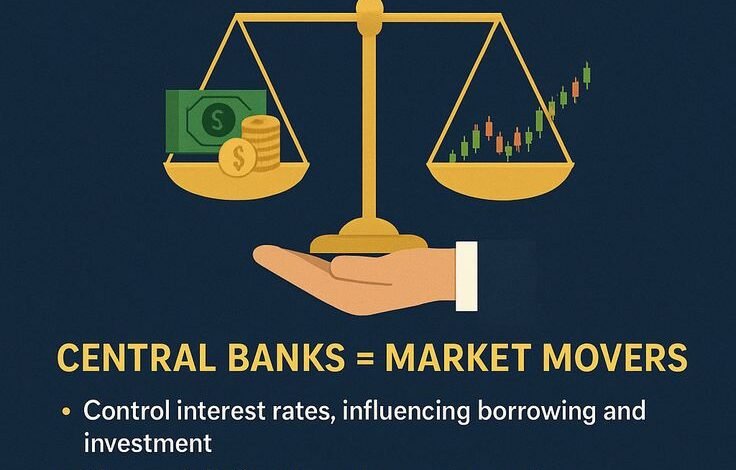
Central banks have become one of the most closely watched institutions in the global economy. Their decisions about interest rates, inflation, money supply and financial stability can quickly influence stock markets, bonds, currencies, businesses and household finances.
For investors, central-bank decisions are important because they can change the cost of borrowing and the potential return available from different investments. A small change in interest-rate expectations can sometimes trigger large movements across financial markets.
In 2026, investors are paying particularly close attention because central banks are dealing with a complicated economic environment. Inflation remains a concern in some regions, energy prices have been affected by geopolitical tensions, and economic growth is uneven.
At the same time, investors are trying to determine whether borrowing costs will remain high, begin falling or potentially rise again.
So, why are investors watching central banks so closely?
What Do Central Banks Actually Do?
Central banks are responsible for managing monetary policy and helping maintain financial stability.
Some of the world’s best-known central banks include the U.S. Federal Reserve, the European Central Bank, the Bank of England and the Bank of Japan.
One of their most important responsibilities is setting or influencing short-term interest rates.
When inflation becomes too high, a central bank may raise interest rates. Higher rates make borrowing more expensive and can reduce spending and investment.
When economic growth becomes weak or inflation falls sufficiently, a central bank may lower rates to encourage borrowing and economic activity.
Investors closely monitor these decisions because changes in monetary policy can affect the value of financial assets.
Interest Rates Can Move Markets
Interest rates are one of the most powerful tools central banks have.
Suppose a central bank unexpectedly raises rates. Investors may immediately reconsider their expectations for economic growth and corporate profits.
Higher borrowing costs can make it more expensive for companies to finance expansion.
Consumers may also borrow less.
As a result, businesses could experience weaker demand, which may affect earnings and stock valuations.
The opposite can happen when central banks cut rates.
Lower borrowing costs can encourage businesses to invest and consumers to spend.
Investors may also become more willing to buy stocks and other assets that offer higher potential returns.
This is why central-bank announcements can create significant market movements within minutes.
Investors Watch Inflation Data Closely
Central banks do not make decisions based only on the latest inflation number.
They also examine whether inflation is moving sustainably toward their target.
Investors therefore watch consumer-price reports, wage growth, energy prices and other economic indicators to predict what central banks might do next.
Energy prices are particularly important in 2026.
Oil and gas markets have been affected by geopolitical tensions, creating concerns that higher energy costs could push inflation upward.
This creates a difficult situation for policymakers.
If energy prices rise sharply, inflation could remain elevated even if consumer demand is weakening.
Central banks then have to determine whether the inflation increase is temporary or likely to become persistent.
Investors closely follow this judgment.
The Federal Reserve Remains a Major Focus
The U.S. Federal Reserve is one of the most important central banks for global investors.
The U.S. economy is the world’s largest, and the dollar plays a major role in international finance.
Changes in Federal Reserve policy can therefore affect markets far beyond the United States.
When the Federal Reserve raises rates, U.S. government bond yields can increase.
That can attract international investors seeking relatively attractive returns.
The dollar can also strengthen.
A stronger dollar can create challenges for countries and companies that have borrowed in dollars or rely heavily on dollar-denominated imports.
For this reason, investors around the world watch Federal Reserve meetings, speeches and economic projections carefully.
The European Central Bank Matters Too
The European Central Bank is another major focus for global markets.
The euro is one of the world’s most important currencies, and the eurozone represents a large share of global economic activity.
The ECB’s decisions influence borrowing costs for households and businesses across the euro area.
Investors also examine the ECB’s assessment of inflation, economic growth and financial risks.
If the ECB signals that interest rates may remain high for longer than expected, European bond yields could rise.
European stocks can also react as investors reassess the economic outlook.
On the other hand, expectations of future rate cuts can support financial markets by reducing anticipated borrowing costs.
Investors Watch Central-Bank Language
Central banks do not communicate only through interest-rate decisions.
Their statements can be just as important.
Investors carefully examine words such as “inflation,” “growth,” “risk,” “restrictive,” “persistent” and “policy.”
A central bank may leave rates unchanged but signal that future cuts are possible.
That can produce a very different market reaction from a decision that leaves rates unchanged while warning that inflation remains a serious concern.
Investors therefore analyze every central-bank statement for clues about what might happen next.
This is sometimes called forward guidance.
Why Bond Investors Pay Special Attention
Bond markets are particularly sensitive to central-bank policy.
Bond prices and yields generally move in opposite directions.
When investors expect interest rates to rise, bond yields often move higher and existing bond prices can fall.
When investors expect rates to decline, bond prices can rise and yields can fall.
Government bonds are especially important because their yields help determine borrowing costs across the economy.
For example, U.S. Treasury yields influence mortgage rates, corporate borrowing costs and other financial products.
This means a change in expectations about Federal Reserve policy can affect millions of financial decisions.
Stock Markets Also React
Stock investors pay close attention because interest rates influence corporate earnings and valuations.
Companies often borrow money to finance expansion, research, equipment and acquisitions.
Higher interest rates increase those financing costs.
Companies with large amounts of debt may therefore be particularly vulnerable to rising borrowing costs.
Growth companies can also be sensitive to interest rates because investors often value them based on expected future earnings.
When interest rates rise, those future earnings may become less attractive in today’s terms.
However, not every company responds to interest-rate changes in the same way.
Banks, for example, can sometimes benefit from higher rates because lending can become more profitable.
Energy companies may be influenced more strongly by oil and gas prices than by central-bank decisions.
This is why investors look at monetary policy together with individual company fundamentals.
Currencies Can Move Quickly
Central-bank decisions can also cause significant changes in currency markets.
Investors often compare interest rates between countries.
If U.S. interest rates are significantly higher than rates in another major economy, investors may find dollar-denominated assets more attractive.
This can increase demand for the dollar.
The same principle applies to other currencies.
A central bank that unexpectedly raises rates can sometimes see its currency strengthen.
A surprise rate cut can have the opposite effect.
Currency movements matter because they affect international trade, imports, exports and the value of overseas investments.
Emerging Markets Face Extra Pressure
Central-bank decisions in major economies can have significant effects on emerging markets.
When U.S. interest rates rise, investors may move capital toward U.S. assets.
That can put pressure on emerging-market currencies.
A weaker currency can make imported goods more expensive and increase inflation.
It can also make dollar-denominated debt more expensive to repay.
For countries that depend heavily on foreign investment, changes in global interest rates can therefore have major consequences.
This is one reason investors in emerging markets closely follow decisions made by the Federal Reserve even when those decisions do not directly apply to their own economies.
Central Banks Are Watching Energy Prices
Energy has become an especially important issue for central banks in 2026.
Oil prices can affect transportation, manufacturing, agriculture and household expenses.
If energy prices rise sharply, inflation can increase.
But raising interest rates cannot produce additional oil or repair disrupted supply chains.
This creates a challenge for central banks.
They must determine whether an energy-driven increase in inflation is temporary or whether it is likely to spread into wages, services and broader prices.
Investors are watching these decisions carefully because an extended energy shock could change expectations for interest rates.
Geopolitics Makes the Situation More Complicated
Central banks also operate in an increasingly uncertain geopolitical environment.
Wars and international tensions can disrupt trade, energy markets and supply chains.
These disruptions can affect both inflation and economic growth.
A major conflict could push energy prices higher while simultaneously weakening consumer and business confidence.
That creates a difficult policy environment.
Central banks have to consider whether inflation or economic weakness presents the greater risk.
For investors, this means geopolitical developments can sometimes become monetary-policy developments.
A new conflict can change expectations for interest rates even before a central bank holds its next meeting.
Investors Are Watching for Rate Cuts
One of the biggest questions facing investors is when central banks will begin reducing interest rates, or whether they will be able to reduce them at all.
Rate cuts can provide support for financial markets because they reduce borrowing costs.
But central banks generally want to be confident that inflation is under control before cutting rates significantly.
If they cut too early and inflation returns, they may eventually have to raise rates again.
That possibility makes investors cautious.
Markets therefore react not only to actual rate cuts but also to signals about when future cuts might happen.
What Happens If Rates Stay High?
If central banks keep interest rates high for an extended period, the effects can spread throughout the economy.
Households may delay major purchases.
Businesses may reduce investment.
Housing markets may remain under pressure.
Governments may face higher debt-servicing costs.
Investors may demand higher returns before taking risks.
However, high rates can also benefit savers and investors who hold cash or interest-bearing assets.
The overall impact depends on how long rates remain elevated and how strong the underlying economy is.
What Investors Should Watch
Investors looking to understand central-bank policy should pay attention to several major indicators.
Inflation
Is inflation falling, rising or remaining stubbornly high?
Employment
A strong labor market can support consumer spending, while a weakening job market can signal slower economic activity.
Economic Growth
Central banks generally want to avoid both excessive inflation and unnecessary economic weakness.
Energy Prices
Oil and gas prices can influence inflation expectations.
Central-Bank Statements
The language used by policymakers can provide clues about future decisions.
Bond Yields
Government bond markets often react quickly to changes in interest-rate expectations.
Currency Movements
Changes in exchange rates can reveal how investors are responding to differences in monetary policy.
Final Thoughts
So, why are investors watching central banks closely?
Because central-bank decisions influence the cost of money, and the cost of money affects almost every major financial market.
Interest rates can influence stock valuations, bond yields, currencies, housing, business investment and consumer spending.
In 2026, investors face an especially complicated environment because central banks are dealing with inflation, geopolitical tensions, energy-price uncertainty and uneven economic growth at the same time.
For investors, the most important question is not simply whether a central bank raises or lowers interest rates.
The bigger question is what policymakers believe will happen next.
A central bank that signals rates could remain high may produce a very different market reaction from one preparing for future cuts.
That is why investors study central-bank meetings, economic data, speeches and policy statements so closely.
As global markets continue to respond to inflation, energy prices, economic growth and geopolitical developments, central banks will remain among the most important forces shaping investment conditions.
For anyone following the global economy, understanding what central banks are saying can provide valuable insight into where markets may be heading next.